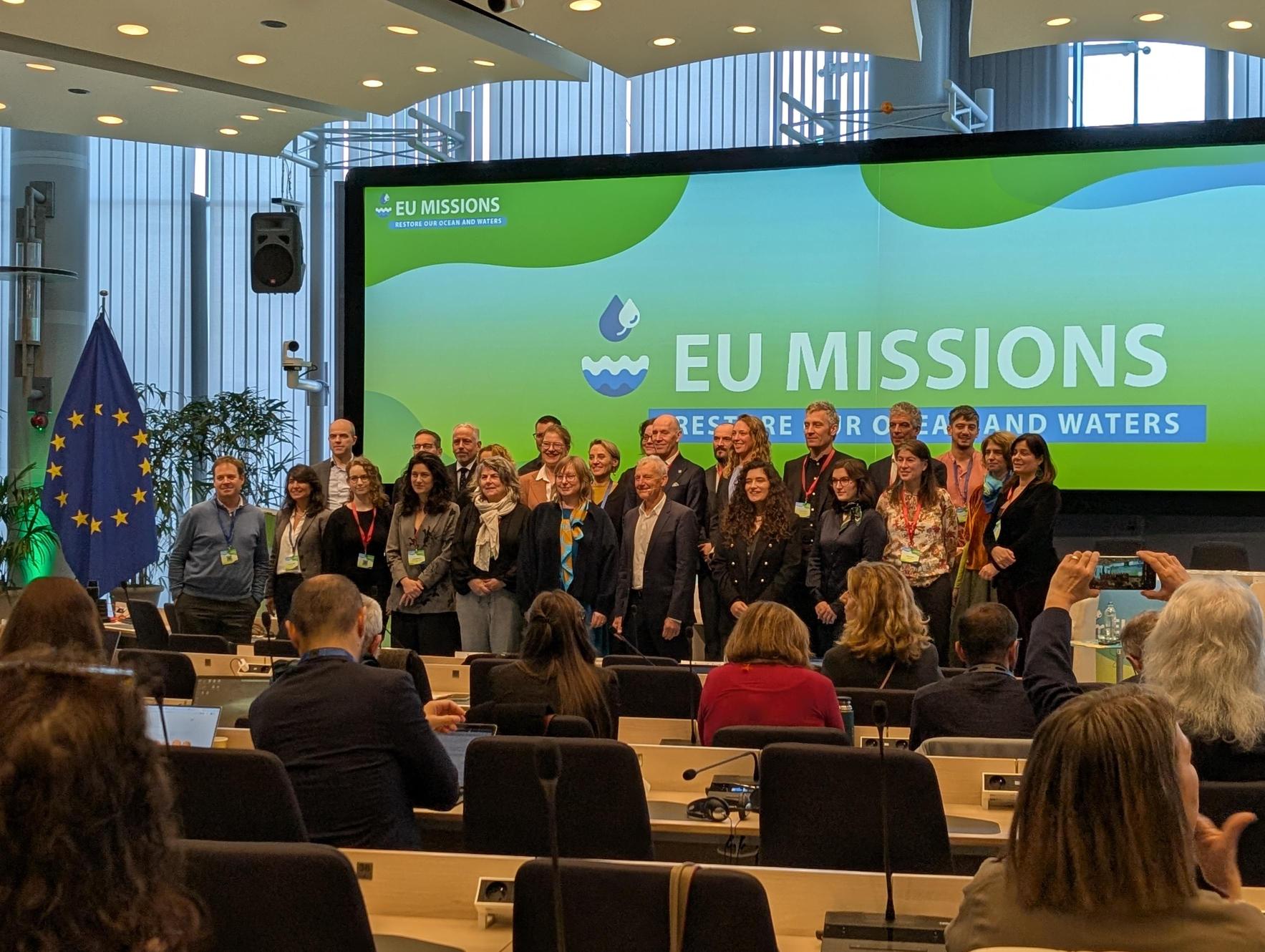
A Week of Dialogue, Innovation, and Networking
The overall impression from the European Ocean Days was one of momentum and collaboration. Key discussions focused on the development of the European Ocean Pact, the importance of empowering coastal communities, and the need to translate ambitious political targets into effective, on-the-ground action. For the MPA Community Network, the event provided a valuable platform not only to follow policy developments but also to connect with a wide range of initiatives and national representatives. These exchanges reinforced the importance of collaboration across sectors and countries to address shared marine challenges.
Showcasing Tools for Marine Protection
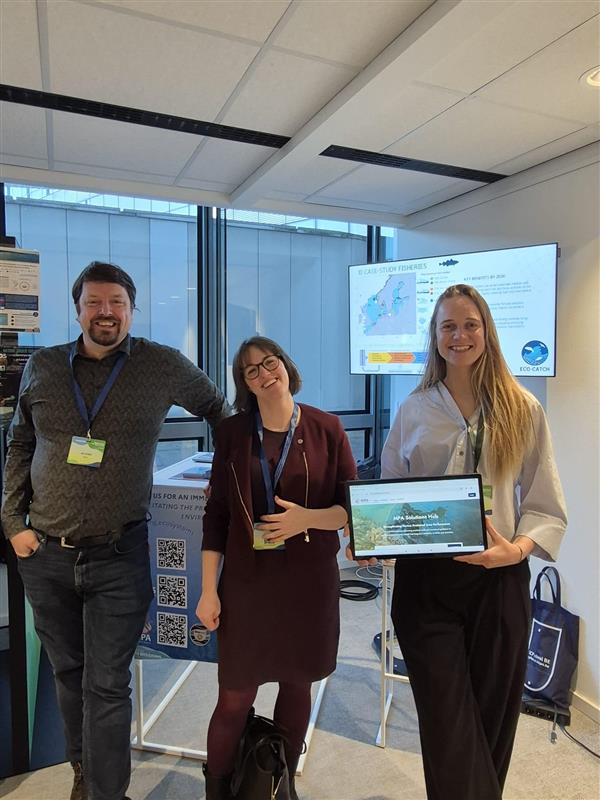
At the event, the MPA Community Network co-hosted a booth together with several of its member projects, presenting a suite of innovative tools designed to support marine protected area (MPA) management:
- Pharos 3D Integrated Aquaculture System: Demonstrated using virtual reality, this system offers an immersive look at sustainable aquaculture solutions. Notably, it is expected to be deployed at real scale in the water later this year.
- BioProtect Marine Planner: Currently in its first stakeholder review phase, this tool supports spatial planning and decision-making processes for marine protection.
- Blue4all MPA Solutions Hub: Set for launch in summer 2026, the Hub will serve as a central platform bringing together tools and resources for MPA management from across MPA CN member projects and beyond.
- MPA Card Game: An interactive and educational tool developed within the network to engage stakeholders and communicate key concepts of MPA design, management, and trade-offs in an accessible format.
The strong interest in these tools highlighted a recurring theme throughout the event: while many valuable resources already exist, there is a clear need for better visibility, accessibility, and integration, an objective the MPA Solutions Hub aims to address.

Key Insights from the Blue Parks Community Workshop
A key highlight for the MPA Community Network was participation in the 6th EU Blue Parks Community Workshop on 4 March, which focused on identifying the next steps for the European Blue Parks initiative in support of EU targets beyond 2030.
The discussions provided a timely reminder that, while Europe has made progress in expanding its network of marine protected areas (with around 13.4 percent of EU seas designated according to European Environment Agency data), designation alone is not enough. What matters equally, if not more, is how these areas are protected, connected, and managed.
Across the workshop, it became clear that Europe still faces significant challenges in achieving effective protection. This includes strengthening levels of protection, improving ecological connectivity, and ensuring that management measures are implemented and enforced in practice. Importantly, participants emphasised that effective MPAs cannot be achieved without closer collaboration with local stakeholders. In particular, working with fishers was repeatedly highlighted as essential, as more sustainable fishing practices directly contribute to more effective and accepted MPAs.

Country representatives provided a range of concrete examples that illustrated both progress and remaining challenges. France shared its approach of conducting fishing risk analyses within Natura 2000 sites, allowing only those fishing practices that are compatible with conservation objectives. Spain presented ongoing efforts to establish a transnational Natura 2000 site with Portugal, underlining the need to manage marine ecosystems beyond national borders. Romania highlighted its experience with MPAs of “Community Importance,” while contributions from Estonia and the Netherlands further enriched the discussion.
Throughout these exchanges, two concepts repeatedly emerged as central to the future of MPAs: strict protection and restoration. However, there is still no shared understanding of how these should be consistently defined, implemented, and monitored across Europe. Participants stressed that while a more standardised approach to evaluating MPA effectiveness would be highly valuable, it must remain flexible enough to account for differences in data availability and national contexts. As noted in the discussion, countries vary significantly in both the quantity and type of ecological and socio-economic data they can rely on, making a one-size-fits-all methodology impractical.
A key underlying concern was the risk that MPAs remain “paper parks,” existing primarily to fulfil political commitments rather than delivering real ecological outcomes. While strict protection is a crucial component, it was widely acknowledged that not all areas can or should be strictly protected. Instead, the focus should be on combining a range of measures to build representative, connected, climate-smart, and socio-economically viable MPA networks.
At the same time, structural challenges continue to limit progress. MPAs across Europe are often underfunded, understaffed, and under-resourced. Addressing these gaps will require both increased public investment and the mobilisation of private financing. In this context, the financial guidance developed by the MPA Community Network represents an important contribution to supporting more sustainable and diversified funding approaches.
Another recurring theme throughout the workshop was the fragmentation of existing tools and knowledge. Participants repeatedly pointed out that while many solutions already exist, they are difficult to find and access. The introduction of the MPA Solutions Hub during the discussion directly responded to this need and was met with strong interest, confirming its relevance as a centralised platform for MPA managers and researchers.
Looking Ahead: Strengthening Synergies
The European Ocean Days and the Blue Parks workshop highlighted clear synergies between the Blue Parks community and the MPA Community Network. While the Blue Parks initiative brings a strong institutional and policy perspective, the MPA-CN contributes practical expertise, stakeholder engagement, and on-the-ground experience. Building on these complementary strengths, there is strong potential to deepen collaboration, align efforts more closely, and jointly advance the development of effective marine protected areas across Europe.
Final Reflections
Participation in the European Ocean Days 2026 left the MPA Community Network with new ideas, valuable connections, and renewed energy. The event reinforced both the urgency of the challenges ahead and the opportunities that lie in collaboration, innovation, and shared learning. Returning from Brussels, the network is well positioned to continue contributing to the development of impactful, well-managed, and truly effective marine protected areas across Europe.